


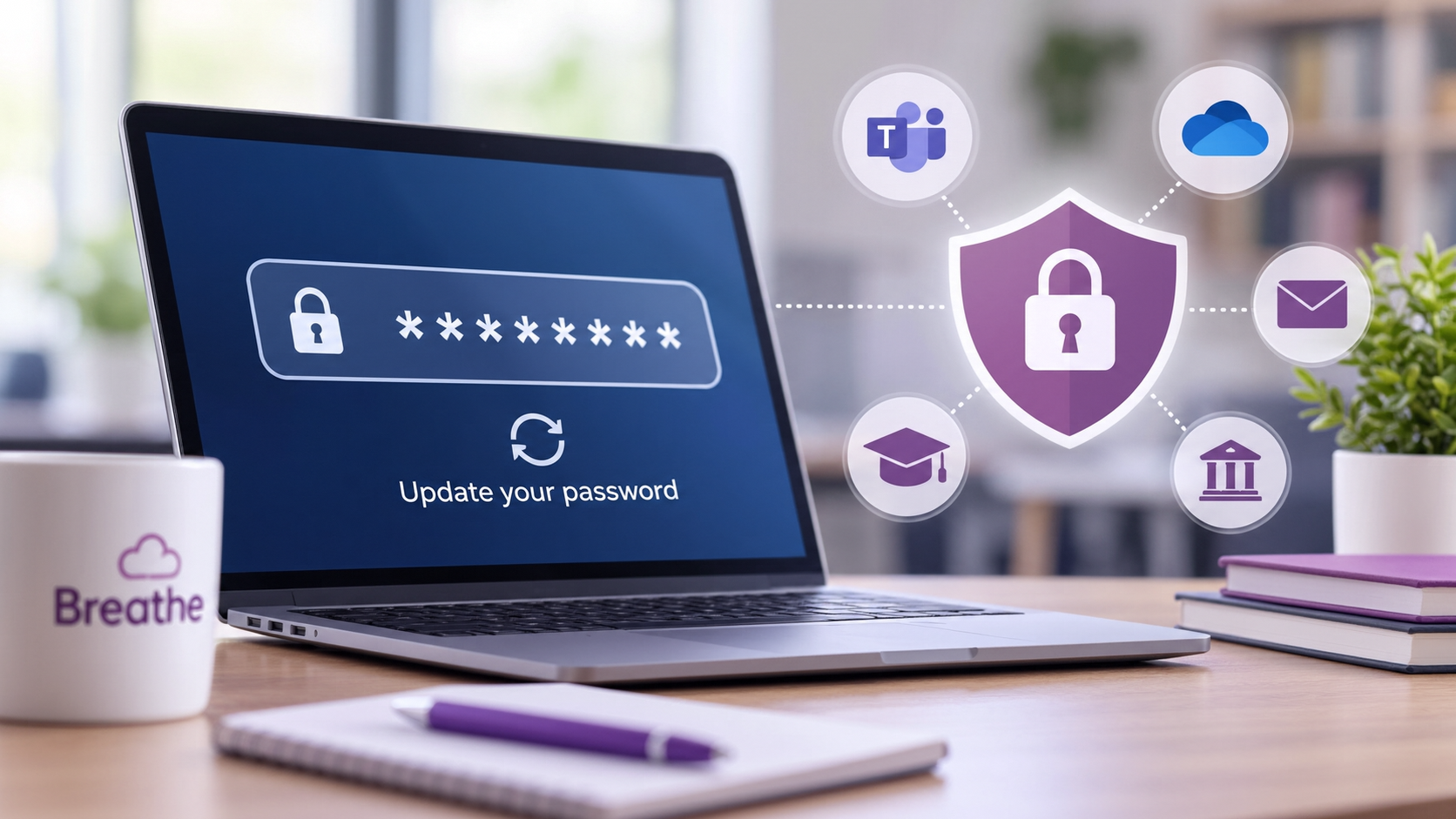
Are you still using a password you created years ago?
(Watch our short video or read the full article below)
When was the last time you changed your passwords?
It’s not something most people think about unless they’re locked out of an account or prompted to create a new one.
For many, the honest answer is, “I can’t remember”.
That can become a problem for any organisation.
Think about how many systems your team accesses every day. Microsoft 365, accounting software, CRM systems, cloud storage, payroll, banking, supplier portals and school management systems. The list quickly adds up.
If someone is still using a password they created several years ago, there’s a chance it has already been exposed in a data breach without them knowing.
When data breaches happen, usernames and passwords can be copied and shared among cyber criminals. If an exposed password is also used to access other organisational systems, it creates another opportunity for attackers to get in.
This is where password reuse becomes particularly risky.
Attackers don’t need to guess dozens of passwords. They can take credentials that have already been exposed and automatically try them across popular business and cloud services. Thousands of login attempts can happen in minutes.
And one successful login is all it takes.
That could give someone access to emails, personal information, customer or pupil records, documents and financial systems.
Using a different password for every account remains one of the simplest and most effective ways to reduce this risk.
Of course, nobody can realistically remember dozens of unique passwords. That’s where password managers come in.
Rather than relying on memorable passwords or making small changes to old favourites, a password manager generates strong, random passwords for each account and stores them securely. Staff only need to remember one master password, while the software takes care of the rest.
Multi-factor authentication (MFA) should also be enabled wherever possible. That extra verification step, usually through an app on a phone, makes it much harder for someone to access an account, even if they have the correct password.
It’s also worth reviewing old accounts and access permissions. Former employees, unused software and forgotten online services can leave unnecessary access points open if nobody takes the time to close them down.
A few sensible habits, supported by the right tools, can make a real difference to your organisation’s security without adding unnecessary work for your team.
If it’s been a while since you reviewed how passwords and account access are managed across your organisation, now is a good time to take another look.
Need a hand reviewing your password security?
Get in touch.
☎️ Camb: 01223 209920 | London: 020 3519 0124
☎️ Suffolk: 0144 059 2163 | Sheffield: 0114 349 8054